Cersaie 2026 Recap: Ceramic Surface Trends That Reach the Kitchen

Cersaie, the big Bologna fair for ceramic tile and bathroom design, ran September 21 to 25, 2026. We don’t exhibit there, but what happens on that floor tends to show up in kitchens a year or two later. Here is a short recap based on the coverage from Canadian Interiors and The Plan.

The numbers

This was the 43rd edition, and it filled all 16 halls of BolognaFiere. There were 595 exhibitors on about 145,000 square meters. Attendance came to 92,352 visitors, down 2.4 percent, and 48.2 percent of them came from abroad. Of the exhibitors, 233 (39 percent) were from outside Italy.

What was on show

  • Cotto d’Este “Shade”: a cement-inspired porcelain slab, 9 mm thick, in eight shades, with a fluted 60×120 cm décor.
  • Atlas Concorde “Log Anthology”: wood-look surfaces modeled on Douglas fir, ash, elm, walnut, teak and zebrano.
  • Casalgrande Padana “Hybla”: a stone look inspired by Pietra Pece and Ragusa stone, in four colors.
  • Laminam, Rare Collection: a new bas-relief finish called “Rain”.
  • Ceramica Sant’Agostino “Lunaris”: a Taj Mahal marble look with a ribbed texture.

Other names in the report include Simas (the “Kallia” collection by Karim Rashid), Porcelanosa and Novabell. In bathroom furniture, Flaminia showed a system with integrated groove handles and a fluted matt lacquer unit.

Ceramic keeps moving into the kitchen

The coverage points out that ceramic is no longer limited to floors and walls. Manufacturers pitch these surfaces for countertops, cooktops, vanities and tabletops as well. For anyone remodeling, that means more choice beyond quartz and stone, such as large slabs with a stone, wood or concrete look.

Two textures keep coming back: fluting and relief. They match what we see on cabinet fronts, where fluted and matte finishes are popular in modern European kitchens.

Our read

This part is opinion, not reporting. If you are choosing surfaces for a contemporary kitchen, ask to see ceramic slabs next to your cabinet finish. Samples tell you more than a catalog. Our guide to kitchen finishes and materials covers the cabinet side, including lacquer, real wood veneer, Fenix, glass and laminate.

Want to see how surfaces and Italian kitchen cabinets look together? Book a consultation and we will walk you through finishes in person, or Get a Quote to get started.

Source: Canadian Interiors, “The Goods: Cersaie 2026” by Lucy Mazzucco (Oct. 12, 2026), canadianinterior.com
Source: The Plan, Cersaie 2026 coverage (edition and attendance figures), theplan.it

US Tariffs on Imported Kitchen Cabinets: What They Mean for Italian Kitchens

If you are planning a kitchen remodel in Chicago this year, someone has probably told you that imported cabinets now come with a tariff. That’s true, but the details get garbled fast, and plenty of articles online are out of date. Here is what the published proclamations say, and where we can’t give you a straight answer.

What the tariff covers

In September 2025 the White House issued Proclamation 10976 under Section 232, covering imported timber, lumber and wood products. Finished kitchen cabinets, vanities and their parts are on that list. Since October 14, 2025, they have carried a 25 percent duty on top of the normal rate.

What happens on January 1, 2027

The first version of the order raised the rate to 50 percent on January 1, 2026. A second proclamation, signed December 31, 2025 (Proclamation 11000), moved that date back a year. The text says the rate “shall increase to 50 percent” on January 1, 2027, except for countries that reach an agreement with the United States.

So for now the rate is 25 percent. If you read somewhere that 50 percent started in early 2026, that source is behind.

Where Italian kitchens fit

For goods from the European Union, the proclamation sets a ceiling: the new tariff should not push the total duty, once the normal rate is added, above 15 percent. Italy is an EU member, so Italian kitchen cabinets fall under that ceiling.

Trade publications in September 2026 report that the EU cap is not scheduled to change on January 1, 2027. We would treat that as a report, not a promise. Proclamations can be amended, and we will update this post if the rules move.

What we can’t tell you

We can’t tell you how much a tariff will add to your kitchen. The final number depends on the brand, how the products are classified at customs, their declared value and freight. Anyone quoting a flat percentage increase for every kitchen is guessing. Nothing here is legal or financial advice. For questions about duties on a specific order, talk to a customs broker.

Questions to ask before you order

  • Does the quote already include duties, or can they change after you sign?
  • How long is the quote valid, and what happens if the rules change before delivery?
  • What are the lead times? Production and shipping set the real calendar.
  • Which parts of the kitchen are imported, and which are sourced locally?

A written quote with a date on it answers most of these. That applies to modern European kitchens, custom kitchen cabinets and any other project with a long lead time.

What this means for your kitchen

Italian kitchen cabinets are still a sound choice. Frameless construction, precise hardware and a wide range of finishes are the reasons people buy them, and none of that has changed. What has changed is that timing and written pricing matter more than before. We design with 3D software during your free consultation, so you see the layout before any numbers are final.

Planning a kitchen and wondering how timing and pricing fit together? Book a consultation at our Lakeview showroom, or Get a Quote to get started.

Source: Proclamation 10976, Sept. 29, 2025: https://www.govinfo.gov/content/pkg/FR-2025-10-06/pdf/2025-19482.pdf
Source: Proclamation 11000, Dec. 31, 2025: https://www.federalregister.gov/documents/full_text/html/2026/01/09/2026-00327.html

Doimo Cucine 2026 Update: Independent Certifications, a Madrid Installation, and Laviani on the Kitchen

A kitchen is one of the biggest purchases you’ll make for your home, so the news that matters most isn’t always a new color or a new handle. This year, Doimo Cucine has been busy on three fronts: proving how its kitchens are made, showing what its new Impronta collection looks like in real rooms, and putting its artistic director on stage. Here’s what’s new, and what it means if you’re planning a kitchen.

Independent Proof of Quality: Two New Certifications

As of July 2026, Doimo Cucine kitchens carry two new certifications from the Catas Certification Institute, the leading Italian testing and certification body for the European wood and furniture sector. Because Catas is an independent third party, these aren’t marketing claims — they’re verified results.

The first is the Catas Quality Award, completed with the Mechanical Safety Requirements programme. It shows that Doimo’s kitchens meet the testing methods set out in the European standard EN 14749:2016+A1:2022, and it supports compliance with the EU’s General Product Safety Regulation. The notable detail: Doimo says it is the first company in the Italian furniture sector to be certified for an entire product system rather than a single product.

The second is the Italian Origin of Furniture certification. It makes “Made in Italy” something you can verify rather than simply read on a brochure: semi-finished components must be manufactured, or receive their final processing, in Italy, and the products must pass Catas performance tests for safety.

Why it matters to you: a kitchen is used every day for many years. These are European standards rather than US ones, but independent testing on safety and origin is still a practical way to compare brands beyond appearance, and a good question to put to any European kitchen maker you’re considering.

La Cocina como Impronta: The Impronta Collection at Casa Decor Madrid

From April 9 to May 24, Doimo Cucine used Casa Decor, the itinerant Spanish interior design event, to show its new Impronta collection in a lived-in setting. Now in its 61st edition, this year’s Casa Decor was hosted in a 19th-century building on Calle San Agustín in Madrid’s literary quarter, the Barrio de las Letras, which is being converted into a hotel.

Doimo Cucine Desco kitchen from the Impronta collection
The Desco composition from Doimo Cucine’s Impronta collection. Photo courtesy of Doimo Cucine.

The installation, titled “The Kitchen like an Impronta,” was built around Desco, one of the compositions in the new Impronta collection designed by architect Ferruccio Laviani and his team. Desco centers on an essential island that is warm and functional, with a minimal, natural design made to be lived in rather than admired from a distance. The listed materials tell the story: vertical oak veneer, a supersilver glass door, and marble-look porcelain stoneware. There’s even a surprise, a wine cellar tucked behind the linear kitchen units and reached through a door panel.

On April 28, Doimo and porcelain manufacturer Florim hosted an invitation-only presentation for interior designers, architects and journalists, using Florim’s matte marble-effect porcelain in the kitchen and the wine room.

Ferruccio Laviani on Why the Kitchen Matters

On June 18, Laviani, Doimo Cucine’s artistic director, sat down at .Ettore, the Doimo family’s historic shop in Treviso that now works as a concept store, for a conversation with Aurelio Magistà, editor-in-chief of Repubblica Design. The evening traced four decades of design, from a career that began almost by accident to collaborations with Achille Castiglioni, Alessandro Mendini, Kartell, Foscarini, Molteni&C, Flos and others.

Coro composition from the Doimo Cucine Impronta collection
Coro, another composition from the Impronta collection designed by Ferruccio Laviani. Photo courtesy of Doimo Cucine.

What stood out for anyone planning a kitchen was how he thinks about the room. He sees it as a creative laboratory and a place for sharing, and he explained that he built versatility into Impronta on purpose, because the way people cook has changed with the pandemic and with modern life. He prefers a closed kitchen for himself, and he even has one in his studio so his team can eat well together around a table.

What to Take From It

Put together, the news points in one direction: Doimo Cucine is investing in verifiable quality and in a warm, natural design language built around how people actually cook. If you’re comparing Italian kitchens, it’s worth asking every brand the same questions: is the quality independently tested, is the Italian origin verifiable, and does the design suit how you really cook?

Want to see how Italian kitchens like these could work in your home? Book a consultation with our design team — or Get a Quote to get started.

Our Showroom Just Got an Upgrade — Take the New 3D Virtual Tour

We’ve refreshed our showroom, and we couldn’t be more excited to show it off. New displays, new finishes on the floor, and a layout designed to let you experience our kitchen and interior collections the way they’re meant to be seen — in person, at scale, with real materials under your hands.

And if you can’t make it in just yet, you don’t have to wait. We’ve built a brand-new 3D virtual tour so you can walk through the showroom from wherever you are, explore the collections at your own pace, and get a feel for the space before you visit.

Take the virtual tour →

Of course, nothing beats seeing it in person. Book a consultation to visit us and experience the collections firsthand — or Get a Quote to start planning your project.

Kitchen Cabinet Finishes & Materials: A Guide to What Our Brands Offer

Two kitchens can share the exact same door style, the exact same layout, even the exact same architect — and still cost twice as much, scratch within a month, or look completely different ten years from now. The difference almost never lives in the shape. It lives in what the surface is actually made of.

Across our Italian kitchen partners — Arrital, Binova, Pedini, Doimo Cucine, and Miton — the material palette has never been richer, or more confusing to shop. Matte or gloss? Laminate or lacquer? Real wood, or a laminate convincing enough to fool your dinner guests? Here’s the vocabulary you need before you pick a single color.

Continue reading Kitchen Cabinet Finishes & Materials: A Guide to What Our Brands Offer

Beyond the Kitchen: Novamobili, Archeda, and Ronda Design at Milan 2026

Italian design news isn’t only about kitchens. This year, three brands working in storage, bathroom furniture, and sculptural metalwork all used Milan Design Week and its surrounding events to show how much room for innovation still exists outside the kitchen itself.

Novamobili: Living Beyond the Surface

For Milan Design Week 2026, storage and living specialist Novamobili unveiled “Living Beyond the Surface. Where Design Becomes Expression” at its flagship store in Milan’s Portanuova district — an installation built around the relationship between matter, light, and transparency.

Novamobili Milan Design Week 2026 installation
Novamobili’s “Living Beyond the Surface” installation at its Milan flagship store. Photo courtesy of Novamobili.

New product news backed up the concept. Velia introduces transparent storage units in aluminum and glass, while the modular Box 18 system gains curved modules and new vertical elements for more architectural, customizable compositions. The collection is rounded out by the Hashi table from designer Matteo Zorzenoni, the modular Kiri sofa by egg-s, open Rail storage units, and new versions of the Agel seating collection. A recurring material note across the installation was the Vibra panel, a three-dimensional slatted surface that brings rhythm and depth to a room.

Material innovation was a real focus, too: natural marble in new warm tones, an engineered stone-look surface called Eternastone, and a lightweight ceramic surface dubbed Light Stone. On the sustainability side, Novamobili introduced a Bio water-based lacquer made with renewable plant resins, aimed at cutting VOC emissions and improving indoor air quality — alongside veneers and wood finishes sourced from certified, recycled supply chains.

Archeda: A Milestone Year for the Tulle Collection

Italian bathroom furniture brand Archeda marks its 30th anniversary in 2026, and it’s using the occasion to expand one of its signature lines. The Tulle collection now includes new curved end units, softening the system’s geometry with fluid, continuous lines in place of rigid corners.

Archeda Tulle bathroom collection curved end units 2026
Archeda’s Tulle collection with new curved end units, marking the brand’s 30th anniversary. Photo courtesy of Archeda.

The technical highlight is a curved end unit with a triple-opening option — offered in both an inward-opening version, which eliminates lateral bulk near walls or fixtures, and an outward-opening version for easier, more direct access to storage. It’s a case of turning a purely functional requirement into a genuine design feature. The new pieces debut in a Tulle composition finished in Rigato Bianco Opaco, paired with a Tecnoril top with integrated basin, the Raggio mirror with perimeter lighting, and the LUX lamp — a full, coordinated bathroom scheme rather than a single standalone update.

Ronda Design: A First-Time Move to the Heart of Milan

After ten years exhibiting at Fiera Milano Rho, metal and magnetic-furniture specialist Ronda Design made a deliberate change for 2026: stepping into the city center itself, joining FOCO by Archiproducts for a more open, informal Fuorisalone presence.

Ronda Design Fuorisalone 2026 FOCO installation
Ronda Design’s installation at FOCO by Archiproducts, Fuorisalone 2026. Photo courtesy of Ronda Design.

The centerpiece was Magnetika, Ronda Design’s modular magnetic wall system, shown in a configuration enriched with new Gelosia lighting modules that turn light into part of the composition itself, alongside the Linearetta shelf with integrated LED. The brand’s well-loved Levia bookcase also appeared in its backlit Levia LED version, using integrated lighting to turn a simple shelving piece into a genuine focal point. Rounding things out, the Jupe table introduced new back-lacquered glass finishes designed to catch and reflect light differently depending on the room and the angle.

The location shift wasn’t incidental — Ronda Design described it as a chance to connect with architects and designers in a more direct, conversational setting, and the FOCO installation will remain open through January 2027 for anyone who wants a slower look.

Why It’s Worth Watching

Storage, bathroom furniture, and architectural metalwork rarely get the spotlight kitchens do, but all three of these brands are using material innovation — glass, ceramic, backlit metal — to do real design work rather than simply decorate. If you’re planning a renovation that extends past the kitchen itself, these are useful names to have on your radar.

Thinking beyond the kitchen for your next project? Book a consultation with our design team — or Get a Quote to get started.

Best High-End Kitchen Appliance Brands: 2026 Roundup

Outfitting a luxury kitchen used to mean picking the biggest stainless-steel range you could find. In 2026, it’s more nuanced. The defining idea this year is “quiet luxury” — professional-grade performance that hides in plain sight, integrated behind custom panels and flush with the cabinetry rather than shouting for attention. The best brands now pair commercial-level capability with refined, disappear-into-the-room design.

There’s no single “best” brand, because each one solves a different problem — refrigeration, precision cooking, quiet operation, or fully custom looks. Here’s a roundup of the names worth knowing this year, what each does best, and the trade-offs to keep in mind, followed by a short buyer’s guide.

Sub-Zero, Wolf & Cove — The American Icons

This family of brands is the reference point for many luxury kitchens, and for good reason. Sub-Zero leads in refrigeration: its dual-refrigeration system uses two separate compressors so fridge air stays cool and moist while freezer air stays cold and dry, preventing odour transfer, and its air-purification system (originally developed for NASA) scrubs ethylene gas to keep produce fresher longer. Wolf handles the cooking side with dual-stacked burners and convection ovens built for serious performance, while Cove rounds out the trio with ultra-quiet dishwashers. Many designers pair a Sub-Zero for cold with a Wolf for heat as a default high-end combination.

Miele — Engineering and Longevity

Miele is a pillar of the luxury market, known for building most components in-house and famously testing products to simulate 20 years of average household use. That obsession with durability, along with reliably flush, panel-ready integration for refrigeration and dishwashers, makes it a favourite for seamless, built-in kitchens. If long-term reliability and integrated design top your list, Miele consistently earns top marks.

Thermador — Innovation and Value

Thermador has been innovating in cooking for over a century, best known for its Star Burner (delivering more even flame distribution) and Freedom induction cooktops, plus flexible column refrigeration that lets you configure fridge and freezer columns separately. It’s frequently the value leader among premium brands thanks to strong package deals and rebates. The trade-offs: some wall ovens use single convection, and the digital interfaces can be less intuitive than rivals.

Gaggenau — Ultra-Luxury Statement Pieces

Tracing its roots to 17th-century Germany, Gaggenau is widely considered one of the most prestigious appliance brands in the world — a fixture in high-end residences globally. Its minimalist, Bauhaus-influenced design turns appliances into architectural details, from backlit control knobs to genuinely chef-level steam ovens with fine temperature control. The caveats: controls are more complex than Miele or Wolf, colour choices are limited, and it focuses on wall ovens and specialty appliances rather than pro-style ranges — all at a premium price.

BlueStar — Power and Customization

For homeowners who want a range that feels bespoke, BlueStar is among the most customizable brands available, offering a huge range of colours and trims plus flexible cooktop configurations (French top, grill, griddle). It’s built for cooking first, with very high-output burners and options like true convection, and refrigeration designed to match with all-stainless interiors. If searing, pan performance, and restaurant-level heat matter most, BlueStar is a standout.

Monogram — Modern Luxury with Smart Tech

GE’s luxury line, Monogram, blends craftsmanship with contemporary style — brass-accented ranges, column refrigerators, induction cooktops, and articulating digital displays — plus smart connectivity through the SmartHQ app. It delivers a refined, tailored look with modern-home features at a competitive price relative to the legacy luxury names, making it a strong choice for tech-forward, design-conscious kitchens.

La Cornue — The French Range as Centerpiece

If you want the range itself to be the focal point, La Cornue has handcrafted ranges in France since 1908. Its flagship Château line is built by a single craftsman per unit with dozens of custom colour and trim options, while the more accessible CornuFé brings the look in rich enamel colours with brass, chrome, or copper trim. It’s the closest thing to couture in the appliance world — a true statement piece for heritage and modern kitchens alike. (Lacanche offers a similarly elegant, slightly more understated French alternative.)

Worth Knowing: Dacor, Café & More

A few other names round out the field. Dacor (backed by Samsung) pairs sleek minimalist design with smart, Wi-Fi-enabled ovens and refrigerators and panel-ready options. Café (part of GE) is built around customizable finishes and hardware — matte black or white with copper, bronze, or brushed accents — for buyers who treat appliances as a design statement. At the more attainable end, ZLINE bridges mainstream and ultra-premium with professional-style features and finishes at lower prices, while ultra-luxury refrigeration specialist True and range maker AGA serve specific high-end niches.

How to Choose: A Quick Buyer’s Guide

With so many strong options, a few considerations narrow it down:

  • Suite vs. mix-and-match. Buying a full suite from one brand gives a cohesive look and often better package pricing and simpler warranties. Mixing lets you choose best-in-class for each category — a common approach is Sub-Zero for cold and Wolf or Miele for cooking.
  • Induction vs. gas. Induction is increasingly favoured in luxury remodels for its speed, safety, and precise control while keeping the kitchen cooler; gas remains the classic choice for those who want a visible flame and traditional techniques.
  • Integration. If you want appliances to disappear behind cabinet panels, prioritize brands engineered for flush, panel-ready fits — Sub-Zero and Miele are noted leaders here.
  • Budget. A full high-end appliance package typically starts around $25,000 and can climb well past $100,000 depending on brands and customization, so decide where to invest first.
  • Service network. Premium appliances need premium support; confirm there’s a strong local service and installation network before you commit.

The Bottom Line

The best high-end appliances in 2026 aren’t defined by a logo on the handle — they’re defined by how well a machine performs and how gracefully it integrates into your kitchen. Match the brand to how you actually cook, entertain, and use the space:

  • Sub-Zero, Wolf, and Miele anchor most luxury kitchens on refrigeration, cooking, and integration.
  • Gaggenau, La Cornue, and BlueStar deliver statement design and deep customization.
  • Thermador, Monogram, and value players offer premium performance at more accessible price points.

Planning a luxury kitchen around the right appliances? Book a consultation and our team will help you select and integrate the perfect suite — or Get a Quote to get started.
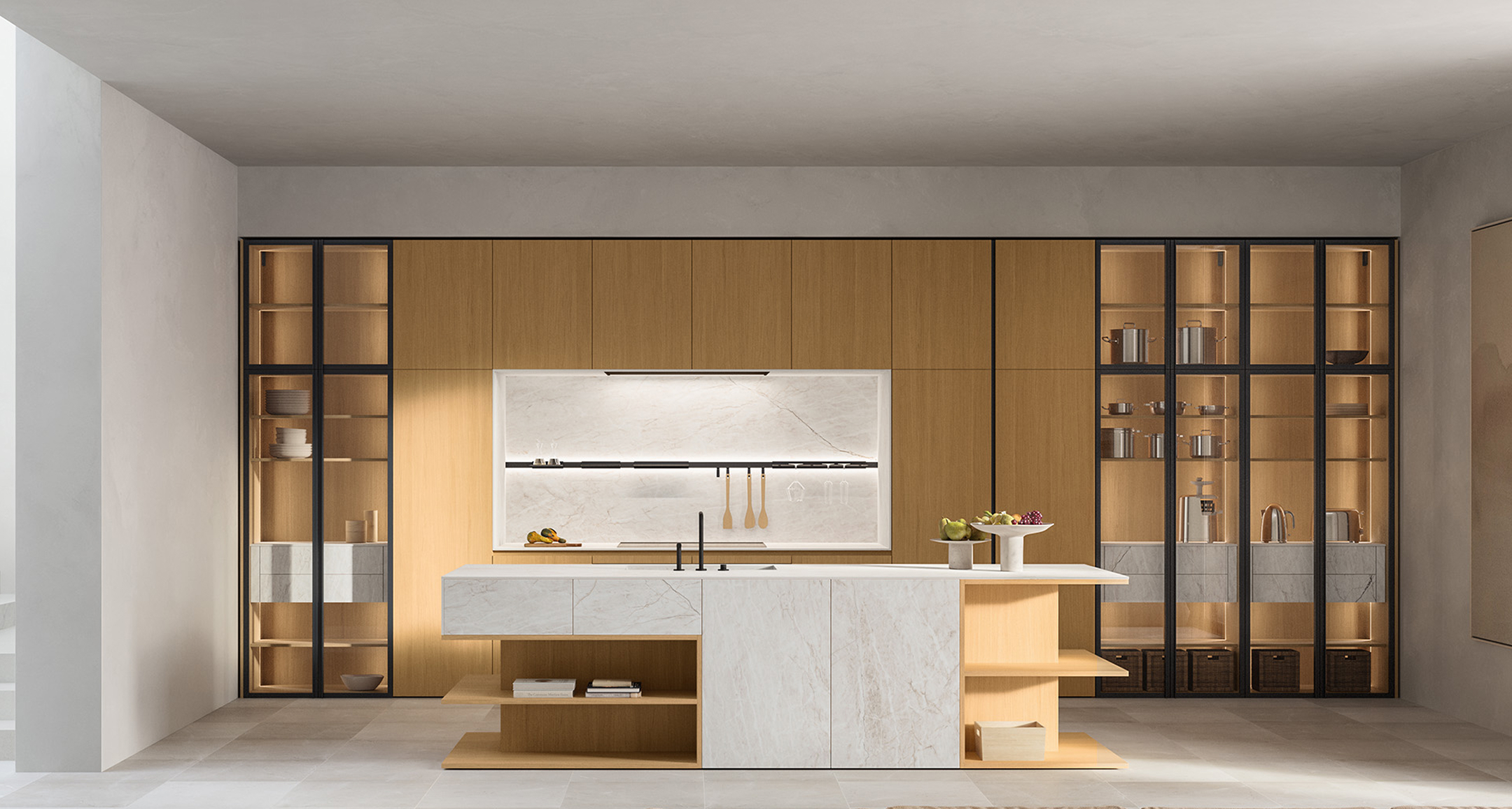
The Ultimate Guide to Buying European Kitchen Cabinets

European kitchen cabinets have gone from a niche import to the global benchmark for modern design. The sleek, seamless, storage-maximizing look that fills today’s inspiration feeds traces almost entirely back to German, Italian, and Scandinavian workshops. But “European cabinets” covers a lot of ground — different construction, materials, brands, and price points — and buying well means understanding what you’re actually paying for.

This guide walks through everything worth knowing before you invest: what makes European cabinets different, how they’re built, the materials and finishes to consider, and how to shop smart. Think of it as the briefing that turns a showroom visit from overwhelming into informed.

What Makes a Cabinet “European”

The defining feature is frameless construction. Traditional American cabinets use a face frame — a hardwood border on the front of the box that doors attach to. European cabinets skip it: doors and drawers mount directly to the cabinet box, creating a full-overlay front with almost no visible gaps. That single difference drives the whole look and much of the benefit.

Because there’s no frame narrowing the opening, frameless cabinets deliver up to around 15% more usable interior space, with wider drawers and easier access. The fronts sit flush against each other, producing the clean, uninterrupted plane that reads as unmistakably modern.

It’s also worth separating system from style. “German” and “Italian” describe the cabinet system — the engineering and build. “Scandinavian,” “French,” or “Mediterranean” describe the style — colours, finishes, and detailing. You can build a Scandinavian-looking kitchen on German cabinetry, which means you can choose engineering and aesthetics independently.

The Construction Details That Matter

With no face frame to lean on, frameless cabinets rely on thicker panels, reinforced backs, and precision hardware for strength — so build quality shows. A few things to check:

  • Box material. Engineered wood provides a stable base for frameless construction; plywood boxes generally cost more than particleboard or MDF-core and resist moisture better. Confirm exactly which panels are plywood rather than trusting a label.
  • Hardware. The “engine” of a European kitchen is its hinges, runners, and lift systems. Quality German hardware from names like Blum and Hettich is what delivers decades of silent, soft-close operation — and it’s worth prioritizing.
  • Precision. Frameless construction is less forgiving of out-of-square walls, so accurate installation by someone experienced with European systems matters more than with framed cabinets.

Materials and Finishes to Consider

European lines offer a wide finish range, and 2026 favours warmth and texture. Your main options:

  • High-gloss lacquer — layered and polished to a mirror finish, glamorous and light-reflecting, but shows fingerprints more readily.
  • Matte lacquer — soft, velvety, fingerprint-friendly, and dominant right now in warm neutrals like taupe and greige.
  • Natural wood veneer — real grain with better stability than solid wood across large fronts; walnut and smoked or roasted oak are surging, especially with sequence-matched grain.
  • Textured fronts — fluted and reeded surfaces add depth and craftsmanship without ornament.

Two-tone schemes — a darker wood base against warmer neutral uppers — remain the leading compositional strategy for adding depth.

German vs. Italian: Which System

If you’re choosing between the two great traditions, it comes down to priorities. German cabinetry leads with precision engineering, modularity, and technologically advanced hardware — ideal if you value ergonomics, longevity, and quiet, flawless performance. Italian cabinetry leads with artistry, material innovation, and bespoke flexibility — ideal if you want a design-forward, statement kitchen and freedom in finishes and dimensions. Both sit at the premium end; German often carries a higher starting price for its internal engineering, while Italian can offer strong design value and easier customization.

How to Shop Smart

A few practical steps separate a confident purchase from an expensive guess:

  • Work with a European specialist. Not every cabinet company builds true frameless construction; look for CNC precision and genuine European expertise.
  • Invest in the hardware. The daily experience — how a drawer glides and stops — lives in the hinges and runners, so don’t economize there.
  • Design the whole system. European cabinets look best when countertops, backsplash, lighting, and cabinetry are planned as one cohesive scheme.
  • See and touch before you buy. Showroom time reveals what a spec sheet can’t: the weight of a door, the silence of a drawer, the exactness of a gap.
  • Get real quotes. Pricing varies enormously with collection and customization, so compare quotes for your specific design rather than relying on averages.

The Bottom Line

European kitchen cabinets earn their reputation through a combination of smart construction, premium materials, and engineering you feel every day. Whether you lean German or Italian, gloss or matte, the throughline is the same — quiet quality built to last.

  • Frameless construction is the foundation — it drives the look, the storage, and the feel.
  • Hardware and box material decide longevity — prioritize both over surface flash.
  • Match system to your priorities and style to your taste — they’re separate choices, and you get to make both.

Ready to explore European cabinets for your kitchen? Book a consultation and our team will walk you through the systems, materials, and finishes in person — or Get a Quote to get started.

What to Ask a Kitchen Designer at Your First Meeting

That first meeting with a kitchen designer sets the tone for the entire project. It’s where a good designer learns how you live and where you figure out whether they’re the right partner for what may be one of the biggest investments in your home. The homeowners who get the most out of it are the ones who come prepared — with the right questions.

A quick note before the questions: come with a little homework done. Bring photos of your current kitchen, inspiration images of kitchens you love, rough measurements, a must-have list, and a budget range. With that in hand, here’s what to actually ask — grouped by what you’re trying to learn.

Questions About Their Experience and Fit

You’re vetting a professional as much as a design, so start there. Ask about their background, training, and any certifications — a certified kitchen designer has met standards set by the National Kitchen & Bath Association. Then dig into fit:

  • How long have you been designing kitchens, and what’s your area of specialization?
  • Can I see a portfolio of past projects — ideally in a style similar to what I want?
  • Can you share client references or testimonials?

A diverse portfolio signals the ability to adapt to different needs; references tell you how responsive they were and whether projects finished on time and on budget.

Questions About Process and Communication

How a designer works day to day matters as much as their talent. Clarify the workflow before you commit:

  • What are the steps from here to installation? (Many firms move from consultation to measurement to a 3D rendering to build.)
  • Will you provide 3D renderings so I can visualize the design?
  • How many rounds of revisions are included, and what’s the turnaround for changes?
  • How often will we communicate, and who is my point of contact?

Some designers stay in close touch throughout; others hand off once the concept is done. Knowing which upfront prevents mismatched expectations.

Questions About Budget and Fees

Money is where projects go sideways, so be direct — and be honest about your own numbers in return:

  • How does your fee structure work — flat fee, hourly, or is design included when I buy cabinetry?
  • Based on my wish list, what’s a realistic ballpark for a project like mine?
  • How do you help keep a project on budget, and how are change orders handled?

A good designer is transparent about cost and keeps your budget front of mind. Remember to fold the designer’s fee into your overall budget, not just the materials.

Questions About Your Space and How You Live

This is where a designer earns their value — translating how you actually use the kitchen into a functional plan. Expect them to ask, and be ready to discuss:

  • How can we maximize efficiency and storage in my specific layout?
  • How many people use the kitchen, and how do you cook and entertain?
  • How should the cabinets be organized — rollouts, dividers, dedicated zones?
  • What layout do you recommend, and why?

Sharing how you live — big family, avid baker, frequent host — is invaluable. The more honest you are about daily habits, the better the design will fit.

Questions About Materials, Timeline, and Installation

Finally, cover the practical details that shape the finished result:

  • What cabinet construction and materials do you recommend, and why? (Framed vs. frameless affects storage, cost, and look.)
  • What’s the realistic timeline, including design and manufacturing lead times?
  • Will you oversee installation, and who’s on site during the build?
  • Do you suggest any sustainable or eco-friendly options?

Lead times vary widely — stock cabinets arrive fast, custom can take months — so understanding the schedule early keeps the whole project realistic.

Walking In Prepared

The goal of the first meeting isn’t to have every answer; it’s to start a productive relationship and see whether this is the right person to bring your kitchen to life. A few reminders:

  • Do a little prep — inspiration photos, measurements, a must-have list, and a budget range make the conversation far more productive.
  • Be honest about budget and habits — a designer can only optimize for the life you actually describe.
  • Ask about process, not just aesthetics — communication, revisions, and timeline determine how the project feels start to finish.

Ready for that first conversation? Book a consultation with our design team and come with your questions — or Get a Quote to get started.

Small Kitchen Storage: 8 Smart Cabinet Solutions

A small kitchen doesn’t have to feel cramped — it just has to be smart. The difference between a compact kitchen that frustrates you daily and one that works beautifully almost always comes down to the cabinets: not how many you have, but how hard each one works.

The good news is that the same footprint can hold far more when every cabinet earns its keep. Here are eight cabinet solutions that turn wasted inches into real, usable storage, so your small kitchen feels like it doubled in size without moving a single wall.

1. Go Vertical with Full-Height Cabinets

The most overlooked space in any small kitchen is the air above your head. Cabinets that run all the way to the ceiling reclaim that dead zone for the things you reach for less often — special-occasion platters, seasonal items, backup supplies. As a bonus, they create a clean, built-in look and eliminate the dust-collecting gap on top.

2. Swap Lower Cabinets for Deep Drawers

Deep pot-and-pan drawers are one of the highest-impact upgrades in a small kitchen. Instead of crouching and reaching into a dark base cabinet, you pull the whole contents out and see everything at once. They swallow bulky pots, pans, and mixing bowls, and with soft-close runners and dividers they stay quiet and organized.

3. Conquer the Corners

Corners are where small-kitchen storage goes to die — unless you fit them out properly. Lazy Susans, swing-out trays, and specialized pull-out corner shelves turn an awkward dead angle into a genuine storage powerhouse, bringing items at the very back within easy reach instead of lost in the void.

4. Add Slim Pull-Out Cabinets

Those narrow gaps beside the fridge, oven, or counter run are prime territory. A slim vertical pull-out — just a few inches wide — becomes a full-height rack for spices, oils, bottles, or cleaning supplies. It uses space that would otherwise sit empty and keeps everything visible and reachable in one glide.

5. Build a Pull-Out Pantry

No room for a walk-in pantry? A tall pull-out pantry cabinet delivers much of the function in a fraction of the footprint. Multiple sliding shelves bring canned goods, dry staples, and spices out to you, making excellent use of vertical space in a narrow slot where a traditional pantry could never fit.

6. Claim the Toe-Kick

The recessed strip beneath your base cabinets is usually wasted — but it doesn’t have to be. Toe-kick drawers tuck into that hidden band at floor level, perfect for flat or infrequently used items like baking sheets, trays, placemats, and seasonal linens. It’s storage you didn’t know you had.

7. Work the Cabinet Doors and Interiors

The inside faces of cabinet doors are free real estate. Add racks, rails, or hooks for lids, cutting boards, foil, and small utensils, and fit interiors with adjustable shelves, stackable inserts, and drawer dividers. These low-cost additions multiply capacity inside cabinets you already have.

8. Choose a Storage-Smart Island or Cart

If your layout allows even a compact island or rolling cart, make it work double duty. Islands with drawers, cabinets, or open shelving beneath add both prep surface and storage, while a movable cart flexes in and out as needed — and in the tightest spaces, a fold-down or roll-out option tucks away entirely when you’re done.

Making Every Inch Count

The secret to small-kitchen storage isn’t cramming in more cabinets — it’s making each one accessible, visible, and purpose-built. A few guiding principles:

  • Reach up and down — full-height cabinets and toe-kick drawers capture space most kitchens ignore.
  • Pull out, don’t dig in — drawers, slide-outs, and corner mechanisms beat deep, dark cabinets every time.
  • Plan storage around your habits — store what you use most where you use it, and let the layout follow your daily flow.

Want a small kitchen that stores more and feels bigger? Book a consultation and our team will design cabinetry tailored to every inch of your space — or Get a Quote to get started.