Italian Kitchen Watch: Arrital and Binova Unveil Their 2026 Vision

Milan Design Week has a way of resetting the conversation for Italian kitchen brands, and this year two names on our radar used it to make a genuinely bigger point: the kitchen isn’t a room anymore, it’s the anchor of the whole home. Here’s what Arrital and Binova just showed the world, and why it matters if you’re planning your own kitchen.

Arrital: From Kitchen System to Home Ecosystem

At Milan Design Week 2026, Arrital took its Ak Project kitchen system somewhere new. Rather than presenting another collection of standalone pieces, the brand unveiled what it calls a “home ecosystem” — a cohesive language that carries the kitchen’s architecture into the living room, storage, and even outdoor spaces.

Arrital Milan Design Week 2026 kitchen and living ecosystem
Arrital’s 2026 home ecosystem, unveiled at Milan Design Week. Photo courtesy of Arrital.

The kitchen itself leans further into an architectural feel this year: clean volumes, seamless surfaces, and 45-degree joints give Ak Project an almost monolithic presence that organizes a room rather than simply filling it. Storage takes on a new role too. New pieces like Index, a flowing bookshelf-meets-display system, and the Circle sideboard extend that same visual language into the living area, while the Modus table balances a light, airy profile with real material presence.

A few details stood out to us:

  • Secto, a modular, interchangeable partition with a slatted structure, keeps rooms open and connected while still defining separate zones — and it can be finished to match Arrital’s kitchen, living, or bathroom lines.
  • The Pass System door offers an elegant way to divide spaces without losing flow between them.
  • Outdoors, the new Solaria collection and its Ombralux shade accessory extend Arrital’s design language beyond the four walls entirely, making outdoor living usable and dynamic through the day.

The throughline across all of it: storage and connection are no longer afterthoughts. They’re treated as design elements in their own right, coordinated down to interior and exterior finishes.

Binova: Softer Volumes, One Continuous Home

Binova’s 2026 catalogue makes a similar leap, moving the kitchen out of isolation and into what the brand describes as a true “living continuum” — a single, coherent scheme that flows from the kitchen through the rest of the day zone.

Binova Bluna plus Zen kitchen composition 2026
Binova’s Bluna + Zen composition, presented at Salone del Mobile 2026. Photo courtesy of Binova.

The headline pieces are reworked versions of two Binova favorites, Bluna and Balance, both softened with new curved end units that round off what used to be sharp corners. In the Bluna project shown at Salone del Mobile, a striking island in Ebano Makassar wood-effect composite is framed by twin curved volumes and finished with Stone handles in Breccia Imperiale-textured grès — a material and handle pairing designed to feel sculptural rather than purely functional. A parallel Bluna + Zen composition introduces glass display cabinets integrated directly into the base units for the first time, a detail previously reserved for tall storage only.

Binova also brought real material innovation to the table: a renewed range of composite woods, an acrylic glass-effect laminate that’s picked up multiple design awards, and a new acid-etched glass finish for cabinet doors that mimics the look of raindrops running down a windowpane. And in a notable first for the brand, Binova unveiled its debut line of non-kitchen storage systems — wardrobes and closets built on the same design language, signaling the brand’s ambitions well beyond the kitchen.

Why This Matters for Your Kitchen

Both brands are pointing at the same shift: the kitchen is increasingly designed as one continuous statement with the rest of the home, not a room that stops at its own doorway. If you’re planning a renovation, that’s a useful cue — matching finishes, storage logic, and material language across the kitchen and adjoining living space is what reads as considered, not incidental, in 2026.

It’s also a reminder that the details worth asking about aren’t just door colors and countertop stone. Ask how storage is designed to connect spaces, whether curved or softened volumes are available in the lines you’re considering, and what material innovations (like acid-etched glass or acrylic laminates) might be worth specifying.

Curious how these ideas could translate into your own kitchen? Book a consultation with our design team to explore European systems like these in person — or Get a Quote to get started.
German vs. Italian Kitchen Cabinets: Key Differences

Ask a designer to name the two peaks of European cabinetry and you’ll hear the same answer every time: Germany and Italy. Both have centuries of furniture-making behind them, both sit at the top of the luxury market, and both are worlds apart in philosophy. If you’re weighing one against the other, the choice isn’t about which is “better” — it’s about which way of thinking suits how you actually live.

The shorthand you’ll hear repeated is that German kitchens are engineered and Italian kitchens are designed. It’s a useful starting point, but the real differences run deeper than a slogan. Here’s how the two traditions diverge across the decisions that matter most in a renovation — and how to tell which one is right for your home.

The Core Philosophy

German cabinetry is built on the principle that form follows function. Every hinge, drawer, and carcass panel is designed to perform flawlessly under years of daily stress, with production lines automated to fractions of a millimetre. The aesthetic is a by-product of the engineering: clean lines, muted tones, and an understated elegance that comes from everything simply fitting perfectly.

Italian cabinetry starts from the opposite end. It treats the kitchen as a piece of architectural art, leading with beauty, emotion, and material drama. Italian makers push the boundaries of what’s possible with lacquers, veneers, and finishes, and they’re often first to bring a new luxurious material to market. Where a German kitchen creates certainty, an Italian kitchen creates desire.

Neither approach is a compromise. They’re two different answers to the question of what a kitchen is for.

Aesthetics and Finishes

This is where the split is most visible. German kitchens favour restraint: handleless fronts, seamless surfaces, symmetry, and a palette that rarely raises its voice. The goal is a calm, clutter-free room where nothing competes for attention.

Italian kitchens lean into expression. Expect hand-finished lacquers, exotic wood veneers, high-gloss surfaces, marble, and bold material combinations that turn the kitchen into a centrepiece. Italian design also embraces warmth and character more readily, ranging from sleek contemporary to a softer, more classical charm with grooves, curves, and richer textures.

If you want a room that whispers, German has the edge. If you want one that makes a statement, Italian delivers.

Engineering and Hardware

The “engine” of any kitchen — the hinges, runners, and lift systems — is where German cabinetry tends to dominate. German systems frequently feature highly proprietary, technologically advanced hardware engineered for decades of silent, smooth operation, and that engineering is a major reason for the higher average starting price.

Italian kitchens use premium hardware too, often sourced from the same global suppliers, but the design approach tends to prioritise clean lines and visual space over hyper-complex internal mechanics. Both deliver reliability; the German version simply makes the mechanism itself part of the point.

Customization and Flexibility

German cabinetry is built around modularity — pre-engineered units configured with a high degree of flexibility, but within a defined system. That’s reassuring if you like to see exactly how everything fits before you commit.

Italian manufacturers tend toward a more bespoke approach, with greater freedom to play with sizes, textures, colours, and custom finishes. For an unusual space, a fully customised Italian kitchen can sometimes be more cost-effective than forcing a highly standardised German system to fit — and vice versa for a straightforward rectangular room.

Materials and Durability

German makers favour hard-wearing, low-maintenance materials: high-pressure laminates, engineered stone, and lacquered surfaces built to resist wear and stay consistent over time. It’s dependable by design.

Italian kitchens often centre on natural materials and artisanal craftsmanship — rich woods, marble, and ceramic finishes with a depth and tactility that tends to age gracefully, picking up character rather than looking dated. Both are built to last; they simply wear their years differently.

Cost: What Drives the Price

Both traditions sit at the premium end, and pricing varies enormously with collection and customization. As a general pattern, German kitchens often carry a higher starting price because of their investment in complex, proprietary internal engineering and standardized precision. Italian lines can deliver striking design value and flexible customization, sometimes offering a stronger “value for money” proposition when you want an artistic look without paying for engineering you may not need.

The honest advice: get real quotes for your specific design rather than relying on national stereotypes. A heavily upgraded kitchen in either tradition can close the gap quickly.

Systems vs. Styles: An Important Distinction

One thing that trips up a lot of homeowners: “German” and “Italian” describe the cabinetry system — the build quality and engineering — while “Scandinavian,” “French,” or “Mediterranean” describe the style, meaning the colours, finishes, and detailing. The two are separable. You can build a Scandinavian-looking kitchen on German cabinetry, or a French-inspired kitchen using Italian construction. Understanding that distinction frees you to choose engineering and aesthetics independently rather than assuming one dictates the other.

Which One Is Right for You?

A simple way to decide is to ask what you want your kitchen to prioritise:

  • Choose German if you value precision, ergonomics, longevity, and a minimalist, technology-forward aesthetic. It suits homeowners who want efficiency and quiet, flawless performance above all.
  • Choose Italian if you want artistry, warmth, bold materials, and a kitchen that doubles as the centrepiece of an open, social home. It suits those who lead with design and love a statement.
  • Consider a hybrid if you can’t decide — many premium showrooms deliberately pair one tradition’s build with the other’s look, giving you engineering and expression in one kitchen.

The best decision is rarely made from a brochure. Both German and Italian kitchens reward seeing and touching them in person: the silence of a well-built drawer, the exactness of a gap, the substance of a finish in your hand. Those details tell you more than any spec sheet.

Not sure which tradition fits your space? Book a consultation and we’ll walk you through both German and Italian collections side by side — or Get a Quote for your project.

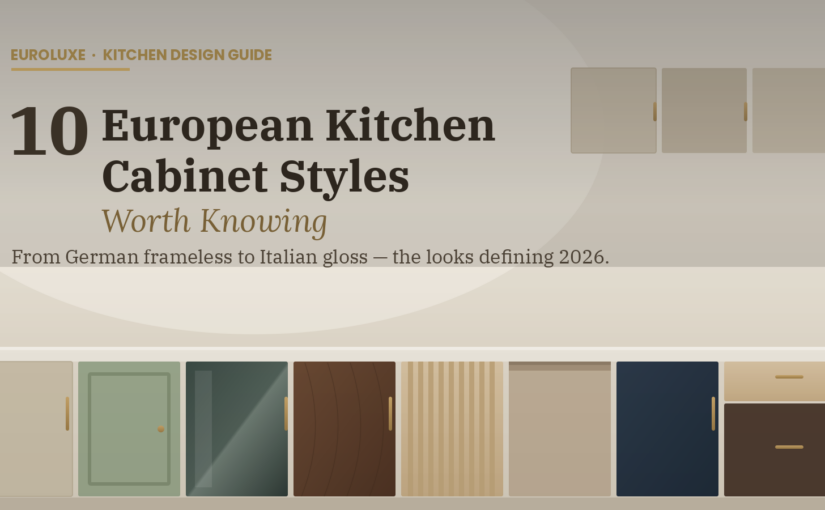
10 European Kitchen Cabinet Styles Worth Knowing

Walk into almost any kitchen being designed in 2026 and you’ll notice the same quiet shift: the cabinetry has stopped shouting. The ornate, heavy fronts that dominated a decade ago have given way to cleaner lines, richer materials, and construction borrowed almost entirely from the Continent. If you’re planning a renovation — or simply love good design — these are the European kitchen cabinet styles worth knowing before you make a single decision.

Europe never really had an “all-white kitchen” era to recover from. For decades, German, Italian, and Scandinavian makers treated the kitchen as furniture-grade architecture: precision-built, seamlessly integrated, and designed to last. That philosophy is now the global benchmark. According to the National Kitchen & Bath Association’s 2026 trends report, frameless construction and flat slab doors are among the fastest-growing specifications in the market — and both trace directly back to European workshops.

Below are ten distinct styles, from the engineering-led German box to the sun-warmed French country cabinet. Each one solves a different problem and sets a different mood, so think of this less as a ranking and more as a vocabulary for describing exactly the kitchen you want.

1. German Frameless (the Euro-box)

If there’s a foundation beneath every other style on this list, it’s German frameless construction. Instead of mounting doors to a hardwood face frame — the traditional American approach — the doors and drawers attach directly to the cabinet box. The result is a full-overlay front with almost no visible gaps, and roughly 15% more usable interior space because there’s no frame narrowing the opening.

What makes it feel unmistakably German is the tolerance. These boxes are cut on CNC machines to fractions of a millimetre, then hung on precision hardware from names like Blum and Hettich. Drawers glide and stop themselves; doors close with a whisper. It’s the least decorative style here and, paradoxically, the most demanding to build well.

Best for: Modern and contemporary kitchens where seamless lines matter more than ornament.

2. Handleless (J-Pull and Integrated Finger Pull)

The single most influential detail in contemporary European design is the disappearing handle. Rather than knobs or bar pulls, handleless cabinets use one of two tricks: a routed “J-pull” channel along the top edge of the door, or a recessed finger gap built into the carcass so you open the door by reaching behind it. Push-to-open and touch-latch mechanisms take it even further, removing hardware entirely.

The payoff is visual calm. With nothing interrupting the fronts, the material itself becomes the focal point, and runs of cabinetry read as a single architectural plane. It’s the detail that makes a kitchen look built-in rather than furnished.

Best for: Minimalist, open-plan spaces where you want the kitchen to recede into the architecture.

3. Italian High-Gloss Lacquer

Where German design leans engineered and restrained, Italian cabinetry has always embraced drama. High-gloss lacquer fronts — layered, sanded, and polished to a mirror finish — bounce light around a room and make even a compact kitchen feel expansive and luxurious. In deep colours like graphite, oxblood, or midnight blue, the effect is unmistakably high-end.

Gloss demands discipline, though. Fingerprints and fine scratches show more readily than on matte, so this style rewards good ventilation, quality finishes, and a household that doesn’t mind the occasional wipe-down. Done right, nothing else reads quite as glamorous.

Best for: Ultra-modern, luxury-forward kitchens and smaller rooms that benefit from reflected light.

4. Matte Lacquer Minimalist

If gloss is the extrovert, matte is the introvert — and in 2026 it’s winning. Roughly 70% of painted cabinet orders now specify a matte or satin sheen. Matte lacquer absorbs light instead of reflecting it, giving fronts a soft, velvety, almost suede-like surface that hides fingerprints and feels wonderfully tactile.

Paired with the warm neutral palette dominating this year — mushroom, taupe, greige — matte fronts create a kitchen that feels calm and grounded rather than clinical. It’s the finish that made the cool, sterile look of early minimalism feel warm and livable again.

Best for: Contemporary kitchens that want minimalism with warmth and low-maintenance surfaces.

5. Scandinavian Light Oak

The Nordic contribution is a whole philosophy: light, airy, honest materials and nothing superfluous. Scandinavian cabinets favour pale woods — white oak, ash, birch — often in flat slab fronts that let the grain do the talking. Finishes stay natural or lightly whitewashed, and hardware is minimal or absent.

The point is atmosphere. In climates with long, dark winters, these kitchens are engineered to feel bright and serene, and that same quality translates beautifully to any home craving a sense of quiet. It’s minimalism with a heartbeat.

Best for: Bright, uncluttered kitchens that prize natural materials and a soft, welcoming mood.

6. English Slim Shaker

Shaker is often assumed to be American, but its refined, pared-back English interpretation has become a modern classic — and designers now overwhelmingly name slim Shaker as the door style of the moment. The recessed centre panel and framed border remain, but the rails and stiles are drawn narrow, giving the door clean geometry with just a whisper of traditional detail.

That balance is exactly why it endures. Slim Shaker sits comfortably in a period cottage or a new-build, in painted sage or deep navy, making it one of the safest choices for resale without feeling generic.

Best for: Transitional kitchens that want a touch of craftsmanship without committing to full traditional or full modern.

7. French Provincial (Country)

At the warmer, more romantic end of the spectrum sits the French country cabinet. Think furniture-like detailing, gently curved profiles, glazed or distressed painted finishes, and open plate racks or glass-front uppers. Where the German box hides its craft, the French cabinet celebrates it — visible hinges, turned feet, and all.

Modern versions dial back the fuss: a soft chalky paint, a bit of beadboard, aged brass hardware developing its own patina. The result is a kitchen that feels collected over time rather than installed in a weekend.

Best for: Farmhouse, cottage, and characterful homes that want warmth, texture, and a lived-in soul.

8. Natural Wood Veneer

After years of painted fronts, real wood is back — and 2026 belongs to darker, richer species. Walnut, roasted and smoked oak, and deep-toned teak are replacing the pale oak of recent years, with nearly 60% of professionals reporting rising demand for dark wood. The luxury detail to look for is sequence-matched veneer, where the grain flows continuously across adjacent doors like a single plank.

Veneer offers the beauty of solid timber with better stability across large flat fronts, which is why premium European makers rely on it. Left natural, wire-brushed for texture, or cerused for a contemporary edge, it brings genuine depth that paint simply can’t imitate.

Best for: Warm, sophisticated kitchens that want the character of real grain, especially in two-tone schemes.

9. Fluted and Reeded Texture Fronts

The newest direction in European cabinetry adds texture without adding ornament. Fluted (concave grooves) and reeded (convex ridges) fronts run vertical channels across doors, drawers, and island panels, catching light and shadow to create rhythm and depth on an otherwise flat surface. Slatted and tambour treatments do the same job with a more architectural feel.

It’s the antidote to flat-surface fatigue. A fluted island or a run of reeded uppers introduces craftsmanship and shadow-play while staying firmly within the clean-lined, handleless world — detail you feel more than you notice.

Best for: Contemporary kitchens looking to break up large flat expanses with tactile, light-catching interest.

10. Two-Tone and Color-Block

Finally, the compositional strategy that ties much of 2026 together: two-tone. Rather than a single finish throughout, designers pair contrasting tones — most resolvedly a dark wood-grain base against warmer neutral uppers, sometimes with a curved island in a third accent colour like muted navy, olive, or deep forest green.

The logic is layering, not contrast for its own sake. A well-balanced two-tone kitchen defines zones, adds visual depth, and lets you introduce a bolder colour in a controlled dose. It’s how you make a minimalist kitchen feel personal rather than showroom-blank.

Best for: Almost any style above — two-tone is less a look than a technique for adding dimension.

Choosing Your Style

The ten styles here aren’t mutually exclusive — the best European kitchens borrow freely. A German frameless box can wear a slim Shaker front; a handleless system can be finished in matte lacquer, natural walnut veneer, or fluted oak. A few principles to steer by:

  • Start with construction, then finish. Decide frameless vs. framed first; it shapes cost, storage, and every aesthetic choice that follows.
  • Match the finish to your life. High-gloss dazzles but shows marks; matte and textured fronts forgive daily use.
  • Invest in the hardware you can’t see. Hinges, runners, and lift systems from quality European makers are what separate a kitchen that ages gracefully from one that sags in five years.

Whichever direction you lean — the engineered calm of a German box, the glamour of Italian gloss, or the warmth of French country — the throughline of European design is the same: quiet quality over loud decoration, built to last.

Ready to bring one of these styles home? Book a consultation and let our team help you translate the look you love into a kitchen built to European standards — or Get a Quote to start your project.